New sales acceleration · From novice to ready to sell
How long it takes a new salesperson to get up to speed often depends on whether they can get timely cases, judgment criteria and feedback. Experienced salespeople have limited time for mentoring, and their methods are not always easy to explain clearly; organizing mature experience can give newcomers a referenceable starting point.
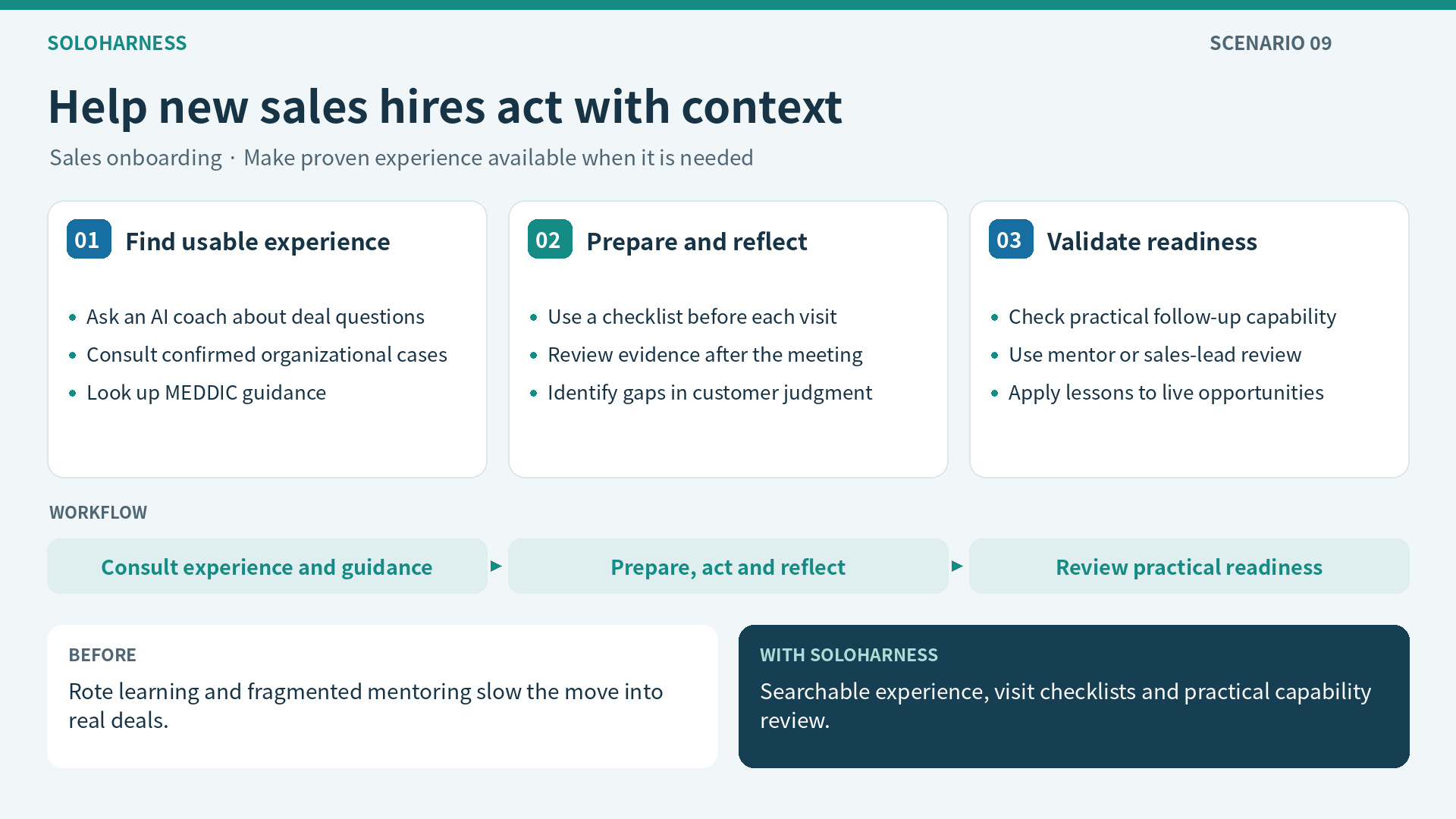
Turn experienced sellers' know-how into cases, question lists and exercises, with the enablement owner continuously refining them based on new hire feedback.
The four root causes of slow onboarding for new salespeople
① Product knowledge and industry knowledge rely on rote memorization, making onboarding slow
What happened:After a new salesperson joins, the first 3 weeks are spent memorizing product parameters, learning industry terminology and attending training. When actually meeting customers, they still don't know what to say. The training content is generic, but customers' actual problems are personalized, and rote-learned content can't be applied.
Result:Essentially no capacity in the first 3 months, equivalent to keeping a half-time employee for 6 months.
② Relying on senior salespeople to mentor, but senior salespeople have no time and their methodology is not systematic
What happened:New sales reps shadow senior reps on customer visits, but the senior reps are busy themselves and have limited time to coach. What's more, senior reps' success is often based on "gut feel" rather than a clear methodology — they can't even explain why they win, so newcomers can only rely on observation and intuition.
Result:New salespeople learn fragmented techniques and can't form systematic judgment; their pace of progress depends entirely on intuition.
③ Don't know how to handle difficult customers, easily spend time on low-quality deals
What happened:When new salespeople face customer rejection or pushback, they don't know how to respond. Common reactions: 1) give up immediately (when there's actually still a chance) 2) keep following up (when they should actually cut losses). Without a judgment framework, everything is handled by gut feeling.
Result:Good opportunities are lost through early misjudgment, while poor ones waste time through persistence for too long.
④ Without top-sales experience to draw on, confidence builds slowly in the first 3 months
What happened:In their first few months, new salespeople have no accumulated experience of successfully closing deals and lack confidence when facing customers. After a few rejections, they easily doubt themselves and feel frustrated, which affects the quality of follow-up.
Result:The stage with the highest turnover rate for new salespeople is 3-6 months after joining.
Organize proven sales experience into reference material for new hires
AI sidekick coach — the "veteran" new sales reps can ask anytime
New sales reps can query the system; the system provides references based on organizational history and confirmed cases, with the final judgment confirmed by the mentor or sales lead:
New sales rep questions
"The customer says our price is 20% higher than competitors — how should I respond?"
AI answer (based on historical win analysis)
→ Historical win data: when a customer says "the competitor's price is lower," the real issue is "not enough value," not "too high a price"
→ Recommended script: Don't cut the price directly; instead quantify the value difference your solution brings ("We understand you care about cost-effectiveness—let me calculate how much more value you'd get in a year using our solution…")
→ Pitfall reminder: when a customer says this, do not offer a discount immediately; first confirm whether they have actually done a TCO comparison
MEDDIC knowledge base — turn the methodology into a queryable tool
New salespeople do not need to read all the training materials before meeting customers; the system can surface relevant materials for a specific scenario, and the mentor still needs to confirm applicability:
The customer is in the "evaluation and comparison" stage
Based on the records for that stage, organize key actions, historical cases and common customer concerns; sales decide how to use them on site.
The customer says "we need to discuss internally"
List whether the Champion is willing to push forward and whether they can introduce the EB as items to verify, for the salesperson to check on their own based on client feedback.
Customer pushes for a price cut of over 30%
Organize historical quotes and concession records, and flag the trade conditions that need confirmation; whether to concede is decided by the sales rep and the manager.
Customer not cooperating during the POC stage
List records showing no POC progress and items that need follow-up questions, then have sales contact the customer to confirm.
Before and after meeting clients, give newcomers a checklist they can verify against
New sales reps can prepare, record and review before, during and after meeting customers based on team materials and checklists:
📋 Pre-visit preparation checklist
Customer background + last follow-up record + objective for this visit + 3 key questions + missing MEDDIC elements
🗣 Real-time prompts during customer meetings
Based on the recorded customer situation, organize similar historical scenarios, questions that can be asked and concerns that need to be checked; the salesperson decides how to ask based on the on-site situation.
📝 Automatic summary after customer meetings
The system can organize: which MEDDIC elements this record covers, which still lack evidence, and what actions can be discussed next; sales must verify before use.
On-the-job capability validation — AI judges whether it can follow up with customers independently
New salespeople must complete the following capability validations in the AI system before unlocking permission to follow up with customers independently:
MEDDIC six-element knowledge test (passed)
Can identify the completeness of the six MEDDIC elements for any opportunity
Customer classification judgment test (passed)
Can make correct ICP scoring judgments for a given customer profile
Handling competitor price-pressure scenarios (in progress)
Must complete 2 simulated price-pressure scenarios, with an AI score of 8 or above
Scenario 9 core comparison
| Metrics | Before | After |
|---|---|---|
| Onboarding time | 6 months or more | 2-3 months, with higher quality |
| Experience transfer | Relying on senior sales to mentor, fragmented and not replicable | Systematically extracted by AI, available for lookup and use at any time |
| Customer judgment | Going by gut feel makes it easy to burn effort on bad deals | The system helps organize evidence, and the lead judges opportunity quality |
| Knowledge acquisition | Learn theory first, then apply it — low efficiency | Scenario-based delivery, learn as you go |
How long does it take your new sales reps to close deals independently?
Break down the process of a new salesperson going from onboarding to closing deals independently, gradually reducing waiting and repetitive communication.