Direction Intervention · Is the Customer Worth Pursuing
Salespeople spending time on the wrong customers is the biggest hidden cost in a sales organization. The problem is often not the level of effort, but that the direction was never calibrated from the start.
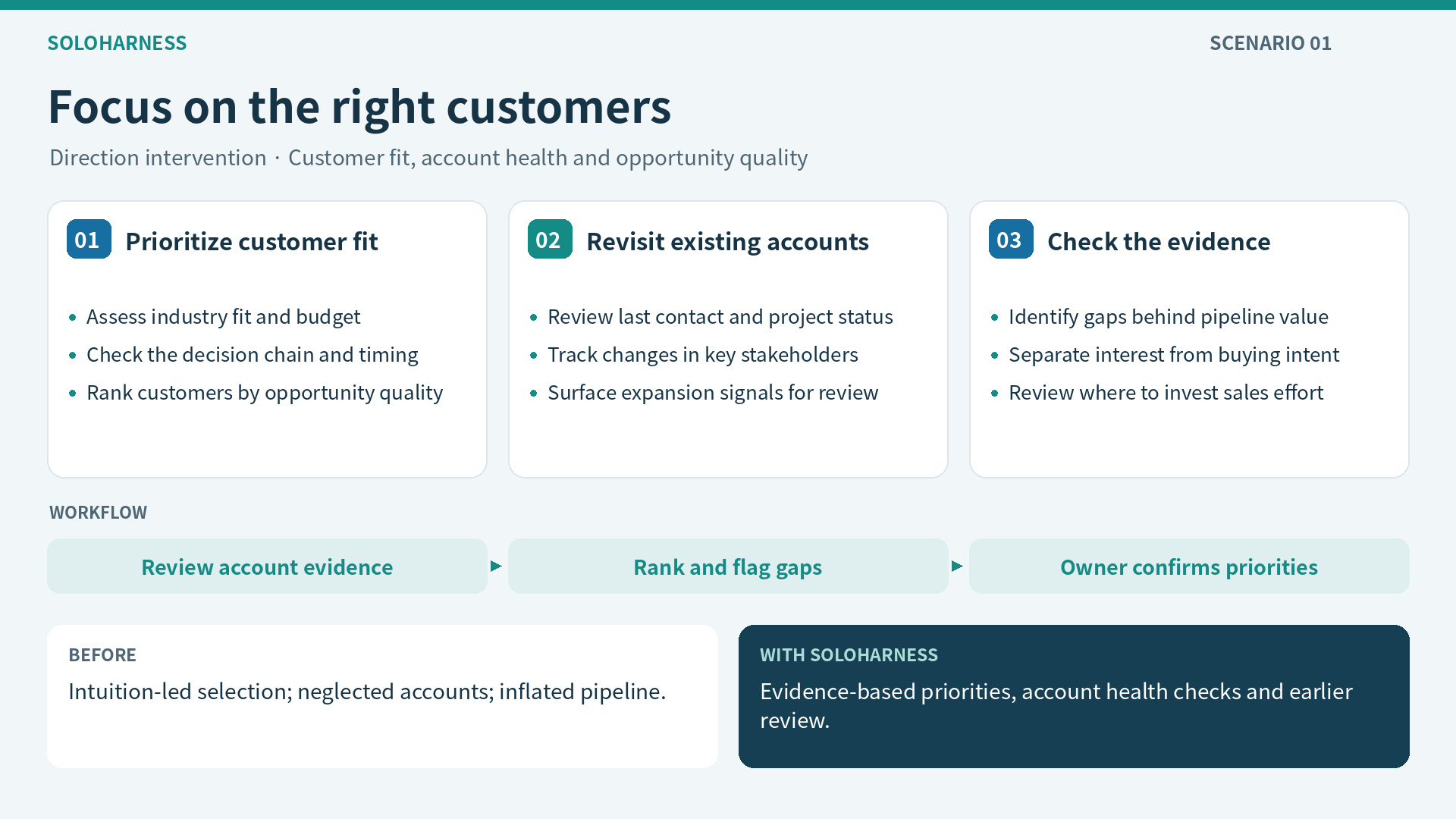
Organize the customer's industry, budget, decision-making relationships and past interactions into a customer priority list, with the sales owner confirming resource investment.
The real dilemma without AI
A Sales picks customers by gut feel, and three months later finds the effort was wasted
What happened:The sales rep followed up for 3 months and held 6 meetings with the client, each time feeling it was "almost there." By the fourth month, the client said, "Our project is on hold, the budget was cut." Only then did the sales rep learn that the decision-maker had changed internally and the budget had been cut from ¥800,000 to ¥200,000.
What is the root cause:No upfront customer value assessment. Sales picked customers based on "it feels right" or "they showed interest", with no ICP (Ideal Customer Profile) scoring mechanism. 3 months of time cost + energy cost, all wasted.
Hidden costs:3 months × 1 salesperson's full effort = about 15% of quarterly sales capacity consumed inefficiently. If the team has 10 people, that's 1.5 people working for nothing all year.
B Existing customers sit in the CRM for 3 years, and expansion opportunities are lost for nothing
What happened:A closed customer bought the first-phase product 3 years ago and never contacted again. Sales were busy following up new customers and had no time to review the old customer pool. In fact, this company had already expanded twice, and each time a competitor seized the opportunity.
What is the root cause:The new customer funnel is always more urgent than existing customer Expansion because there is clear numerical pressure. But the cost of existing customer Expansion is 1/5 of new customer acquisition cost, and the success rate is 2x that of new customers. Sales organizations as a whole overlook this value.
Hidden costs:Expansion deal size is 40% higher than new deals, but managers don't track it, and there's no data on existing customer health. Each of 10 existing customers loses at least 1 Expansion opportunity per year.
C The pipeline numbers look great—until month-end reveals they were inflated.
What happened:At the end of Q2, the pipeline had 20 million in "intent orders" — the numbers looked great. By quarter end, only 4 million converted; the other 16 million were all delayed or cancelled — some because customer budgets were cut, some because there had never been any EB contact from the start, so they didn't count as real opportunities.
What is the root cause:There is no unified standard for judging the "authenticity of an opportunity." To meet quarterly targets, salespeople include uncertain opportunities to inflate the numbers. Managers have no objective data to support them and cannot identify which are bubbles in advance.
Hidden costs:False pipeline numbers lead to misallocated resources—resources go into fake opportunities, while deals more worth pursuing are missed. Quarterly forecast accuracy falls below 50%.
What changes after AI steps in
Real-time ICP scoring + dynamic customer ranking
The system can give a reference score based on the Account's industry fit, budget size, completeness of the decision chain, and timing of entry. When sales opens the system each day, what they see isCustomer list sorted by opportunity quality, prioritize the clients truly worth pursuing.
Example intervention output:
📊 Client priority update | 2026-04-26
• Company A score 72→recommend pausing follow-up (decision-maker has changed roles)
• Company B score 81 → recommend prioritizing this week (EB confirmed attendance at Friday review meeting)
• Company C score 58 → recommend reducing outreach frequency to once this month
Existing customer health monitoring + Expansion signal identification
The system can summarize the most recent contact time, project status and key personnel changes for historical customers. When contact is overdue, it prompts the owner to review and provides Expansion talking points for reference.
Example intervention output:
🔔 Existing Customer Alert | Company D
Days since last contact: 47 (benchmark: 30)
Key contact change: Mr. Zhang (procurement lead) → has changed roles, new decision-maker Mr. Li not yet confirmed
Expansion signal: the company closed 2 funding rounds in the past 6 months and is expanding its IT team
Suggested action: reach out this week, confirm the new decision-maker + probe Expansion needs
Opportunity bubble: identify the evidence gaps first
Put the six MEDDIC elements and known facts in the same record, and identify where EB contact, Champion or budget information is missing; whether to adjust priorities is decided by the manager after review.
Example intervention output:
⚠️ Pipeline bubble warning | Company E
Current Pipeline entry amount: ¥1.8M
AI-assessed real amount: 350,000–500,000 (67% weighting reduction)
Downgrade reasons: EB not directly reached (0 times), Champion missing (unconfirmed), budget only "verbal intent"
Recommendation: lower this opportunity's amount to its true level; do not plan resources based on it
Scenario 1 core comparison
| Metrics | Before (no AI) | After (with AI) |
|---|---|---|
| Basis for customer choice | Sales goes by gut feeling + "they said they're interested" | Six-dimension ICP scoring, dynamic ranking |
| Existing customer expansion | No one manages it; it's up to the salesperson to remember | Health monitoring + automatic identification of Expansion signals |
| Pipeline quality | Bubbles are hard to spot, only discovered at month-end | Real-time authenticity assessment with early warnings |
| Resource allocation | Allocated by experience, high error rate | Data-driven, dynamically adjusted by score |
| Decision timing | You only find out the direction was wrong when problems arise | Early warning, proactive course correction |
Where has your team stopped on this scenario?
Tell us your specific situation, and we'll help you assess how much AI can solve for you.