Fake progress detection · Surface heat vs. real progress
Looking busy on the surface but with no actual forward movement will keep consuming sales time. The problem may not be effort, but a failure to separate signals from facts.
Record replies, meetings and actual customer actions separately, identify evidence of progress and reasons for stagnation, and form a question list for the next communication.
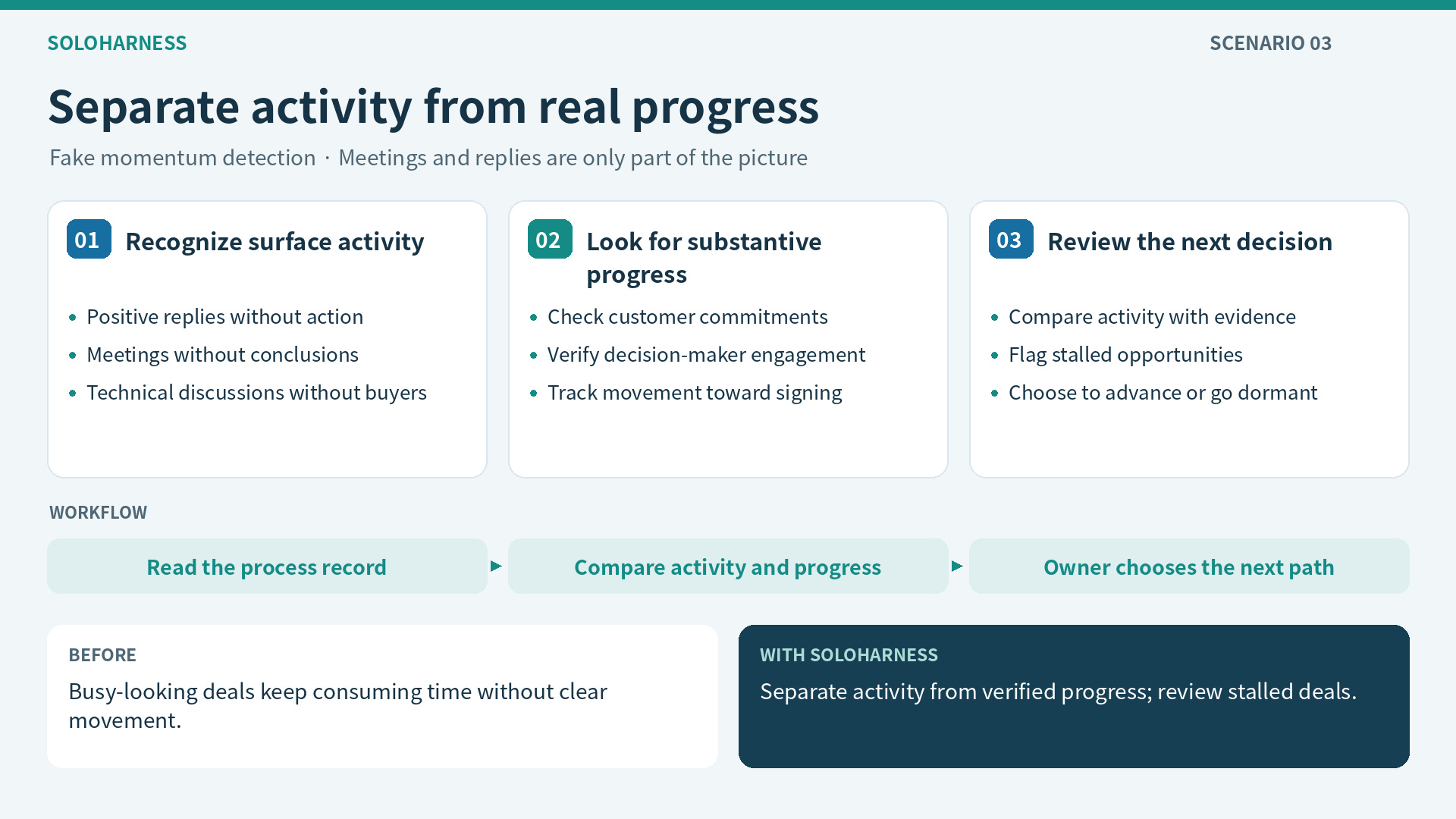
The five most typical forms of false progress
① Positive email replies, but no actual advancement actions
Real scenario:The customer replies to emails promptly every time, saying "Got it, we'll take a look." The sales record notes "continuously positive communication." In reality, the customer has just put you in their email to-do pile and has never actually scheduled time to discuss it.
Identifying features:Each follow-up is more than 2 weeks apart, and every reply is "received/okay/we'll discuss it," with no specific conclusion and no time commitment.
② Lots of meetings, but no conclusions, and the next meeting starts from scratch again
Real scenario:A weekly sync meeting, one hour each time, covering "review last week's progress + confirm next week's plan." Sales feels "the meeting is progressing normally." In reality, each meeting repeats last week's content, because no one actually executed the key actions between meetings.
Identifying features:The meeting turned into a "status report," not a "decision meeting." Every conclusion is "keep pushing forward," but no one knows what specific action "pushing forward" refers to.
③ Stuck at the technical level the whole time, never meeting the business decision-makers
Real scenario:You've talked with the client's technical lead 8 times, discussed the technical solution thoroughly, and they're very receptive. But you've never had a chance to meet the business lead, let alone the EB. Every time sales asks "when can we meet your leadership," the answer is always "let's align internally first."
Identifying features:Contact level stays at IT/technical department, with no business-side (budget owner / decision maker) involvement ever.
④ The customer is friendly but never commits
Real scenario:The customer lead is very enthusiastic at every meeting, saying "your solution is really good" and "we're very willing to move forward." But whenever it comes to specific commitments ("When will the POC acceptance be done?" "When will the budget be approved?"), the other party starts handling it vaguely.
Identifying features:The conversation is full of positive-sounding words, but zero concrete commitments. Timelines are always "TBD."
⑤ The client's internal process dragged on for a long time, but never advanced to the signing stage
Real scenario:The customer says "we're going through the procurement process," and the salesperson thinks "we're close to signing." In reality, the customer hasn't internally decided whether to buy yet—they're just going through an internal process to learn about various vendors. "Finishing the procurement process" does not equal "choosing you."
Identifying features:Using "process" as a shield, but with no purchasing outcome. Sales treat "process progress" as "signing progress."
AI false-progress detection system
Automatic detection of stalled progress + intervention triggers
The system can flag possible false progress based on "missing key milestones." When any of the following exceeds the baseline timeline set by the team, the owner is prompted to review:
- ● Direct EB contact: 21-day benchmark, alert triggered when exceeded
- ● Champion confirmation: 30-day baseline, alert triggered if exceeded
- ● POC kickoff commitment: should be confirmed within 45 days of first contact
- ● Business proposal: a first draft should be completed within 60 days of initial contact
🔴 False-progress alert | Company H
Days since last EB contact: 34 days (benchmark: 21 days)
Contacts in the last 4 weeks: execution level × 4, EB × 0
Key milestones missing: Champion not confirmed, budget not quantified
Verdict: entering a "false-progress loop"; recommend immediately triggering an EB outreach action
"Surface heat vs. substantive progress" dashboard
AI generates a "surface heat vs. real progress" comparison dashboard for each opportunity:
Review mechanism for advancing or going dormant
When an opportunity is flagged as possibly falsely advancing, the system offers two handling paths for the owner to confirm:
Path A: Concentrated push
Must be completed within 3 days:
- ○ Contact EB directly to schedule time
- ○ Explicitly ask about POC timeline
- ○ Ask the customer for a specific signing date
Path B: Move to dormant pool
No response for over 7 days, automatically execute:
- ○ Reduce outreach frequency to once per month
- ○ Mark as "opportunity to activate"
- ○ Resources released to other high-priority opportunities
Scenario Three core comparison
| Metrics | Before | After |
|---|---|---|
| Identification mechanism | Manager's subjective judgment, only discovered at month-end | Distinguish what has happened from what still needs validation based on process records |
| Surface vs. substance | Conflating them | Dual-track progress board presented separately |
| Response mechanisms | No clear path, keep following up | The responsible owner chooses one of two options: advance or put on hold |
| Resource utilization | False progression consumes real resources | Dormant pool automatically releases resources |
What percentage of deals are actually in "false progress"?
First identify opportunities in the team that appear to be moving forward but have not produced a next-step commitment, then check the reasons one by one.