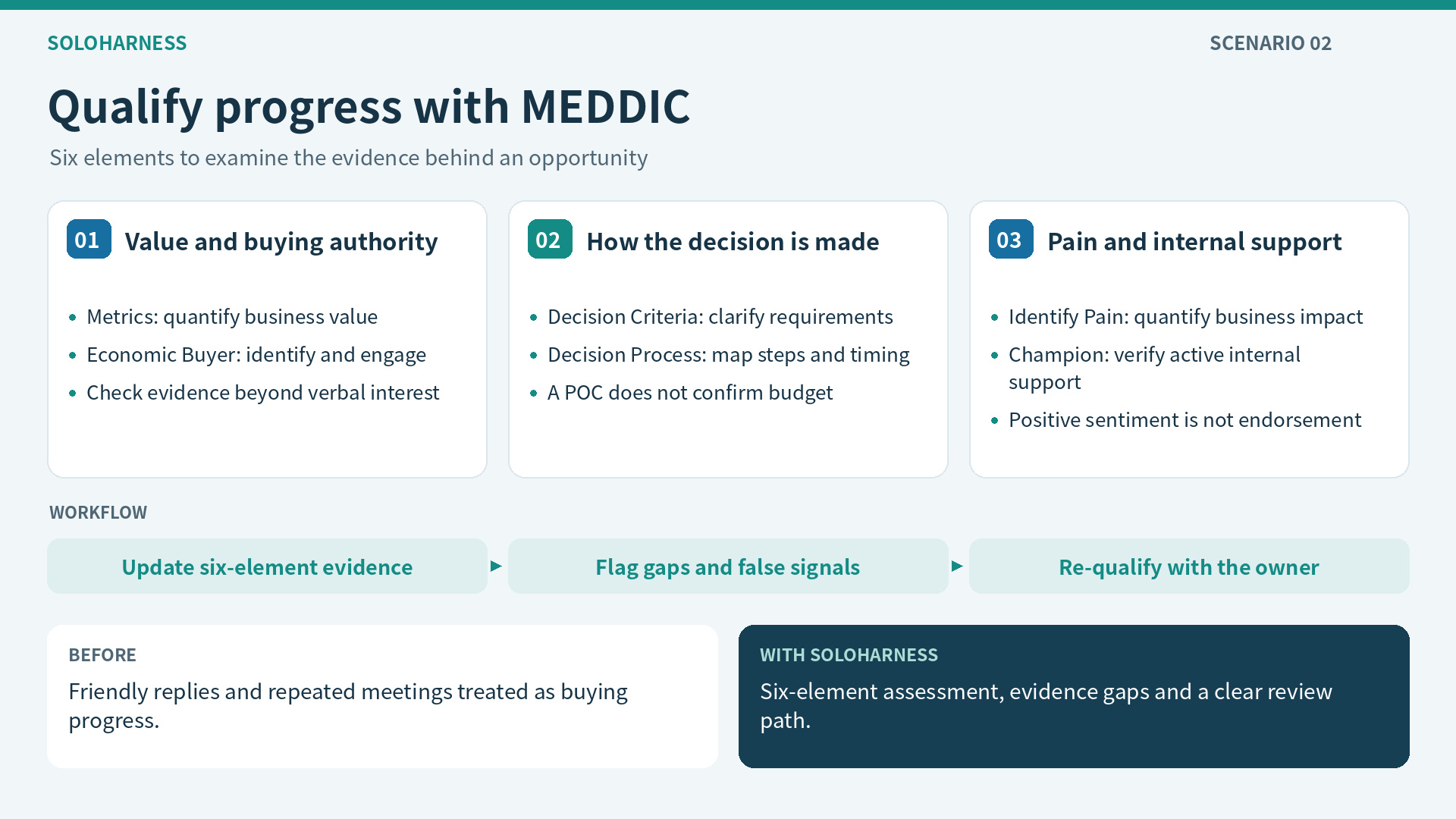
Progress quality intervention · MEDDIC six-element assessment
The purpose here is to look at surface heat and qualifying evidence together, helping the owner judge whether this opportunity is worth continued investment.
Check the customer's statements against MEDDIC evidence item by item, list the information gaps on the decision maker, budget and Champion, and let the owner decide the next step.
The five most common illusions of progress
① "The other party replied positively" does not mean they will actually move forward
Real scenario:The customer replied by email, "Okay, we'll discuss it internally and let you know when we have a result." The salesperson logged it as "actively progressing, follow up next week." In reality, the customer had not scheduled any meeting at all; it was just a polite reply. The salesperson waited 3 weeks, then finally sent a proactive email asking, and the customer said, "Oh, we haven't started discussing it yet."
Why misjudgment happens:Treating an "email reply" as a "progress signal". But a customer's email reply ≠ the decision process starting. It may be that they don't want to refuse directly, that there's simply no internal scheduling, or that your priority is low on their side.
Hidden costs:3 weeks of waiting × 3 proactive follow-up emails = the sales rep spent 1 week of productive work time on a fake opportunity.
② Willing to do a POC ≠ having budget to purchase
Real scenario:The client is willing to join a POC, willing to arrange technical discussions, willing to talk through requirement details. The salesperson thinks, "The requirements are so clear, they'll definitely buy." In reality, the client is comparing 3 solutions at the same time; the POC is just an information-gathering process, and there's no purchasing plan at all.
Why misjudgment happens:POC is a high-weight signal in domestic B2B sales, and salespeople default to "willing to POC = strong intent." But many customers treat POC as free technical consulting and have no intention of paying at all.
Hidden costs:2 months of POC effort × technical support resources × demo materials = a deal with no budget at all consumed half a project's cost.
③ A Champion saying they support you ≠ them actually endorsing you
Real scenario:Someone inside the customer says "this solution is good, we support it." The salesperson takes this as a Champion signal and reports to the manager that "Champion confirmed." In reality this person was only brought in as a reviewer, has no decision-making power, and certainly won't actively endorse it in internal meetings. In the end, it got voted down at the review meeting.
Why misjudgment happens:Mistaking a "positive attitude" for an "endorsed position." But a Champion is essentially "someone who actively advocates for your interests in EB meetings," not "someone who has no objections to your solution."
Hidden costs:3 months of investment + custom solution + POC, lost before the committee meeting. Without a Champion, presenting to the committee is like taking an exam blind.
④ 5 execution-level conversations ≠ close to signing
Real scenario:Had 5 meetings with the customer, each time discussing technical solution details. The salesperson feels "the requirements are getting clearer and clearer, we're not far from signing." In reality, they haven't met the decision-maker (EB), don't know the specific budget, and don't understand the complete decision process. The solution is 90% written when the customer says "our project is on hold for now."
Why misjudgment happens:Mistaking "depth of technical discussion" for "progress". The execution layer can talk with you in great depth, but as long as the EB is not involved, this deal can be rejected at any time for any reason.
Hidden costs:5 technical alignment meetings × schedules of all parties + solution customization = pouring massive resources into a deal that does not even meet the conditions for signing.
⑤ Competitor already signed, but sales still thinks it's "in progress"
Real scenario:The sales rep had great conversations with the customer and thought it was locked in. A competitor's rep quietly signed a POC contract and started moving forward. The sales rep had no idea the competitor was involved and kept "actively following up" every week. Only at the manager's review did they learn the customer had long since gone elsewhere.
Why misjudgment happens:Competitors often enter without making it public early on. The sales rep's follow-up behavior doesn't change, but the actual state of progress already has. Without a mechanism to detect external signals, the sales rep stays in the dark.
Hidden costs:Waste 4-6 weeks on invalid opportunities and miss the time window for other real opportunities in the same period.
Dynamic scoring of the six MEDDIC elements + false-signal detection
MEDDIC six-element real-time scorecard
After each follow-up, the system can organize the six MEDDIC elements based on the record and give a 0-10 reference score:
Budget amount confirmed only verbally, with no written support
EB still not directly engaged, only executive layer met
Technical metrics confirmed; business metrics still to be clarified
Procurement process unclear, no timeline
Technical pain points confirmed, business losses still to be quantified
No confirmed Champion, only a technical contact
⚠️ Overall score 20/60 — Opportunity quality: extremely low, recommend pausing investment or re-qualifying
Real-time false-signal detection + early warning
Competitor entry alert:
🔴 Competitor signal alert | Company F
Signal words detected in the follow-up record: "currently doing comparison testing", "other suppliers"
Most recent occurrence: 2026-04-24
Suggestion: increase outreach frequency, or re-evaluate investment priority
Execution-layer loop identification:
🟡 Execution-layer loop warning | Company G
Six consecutive weeks of contact with execution-level staff only (benchmark: 3 weeks)
No direct EB contact, no Champion confirmation
Verdict: suspected "execution-level discussion loop"; recommend pausing resource investment
Mandatory re-qualifying mechanism
When the opportunity score falls below the agreed threshold, the system prompts entry into a "re-qualifying" review. The owner can require the salesperson to supply the following evidence within one week before deciding whether to move it into the "dormant pool":
- Direct EB call records (at least 1)
- Champion endorsement in writing or recording
- Budget confirmation (figures + timeline)
- Clear decision process (who decides + when they decide)
Scenario 2 core comparison
| Metrics | Before | After |
|---|---|---|
| Opportunity quality assessment | By gut feel, "the other side said they're interested" | Quantified scoring of the six MEDDIC elements |
| False signal identification | Only found out at month-end / after losing the deal | List gaps based on records and hand them to the responsible person for review |
| Champion validation | A positive attitude counts, without verifying willingness to endorse | EB must attend the meeting or confirm in writing |
| Detecting competitor entry | You only find out when the contract is signed | List competitor clues from the conversation and verify them manually in time |
| When the manager steps in | Only step in when problems arise | Automatically triggered when the score falls below the threshold |
Has your team ever had deals that "felt great but didn't close"?
First clarify the MEDDIC elements and the next advancement actions.