Lost-deal review · Find the signals you should have spotted earlier next time
There are already signs a deal is slipping, yet the rep may still say "it's still in play." If there is no post-mortem after a loss, the same problem repeats across different opportunities. Keep the process on record, and a loss becomes the basis for the next judgment.
Summarize signals such as loss of contact, competition and changes in customer decisions, helping the owner arrange verification, reviews and follow-up communication.
Three typical reactions after losing a deal
① The deal is about to be lost, but the salesperson still says "still in talks"
What happened:The deal is clearly dead—a competitor signed the POC, the EB no longer takes calls, and the customer explicitly said "we're not moving forward for now." But the salesperson still tells the manager "it's still in discussion, there's hope." The manager has no data to back up a rebuttal.
Result:The manager only learns the real situation after the other party has already signed the contract. By then, no intervention is possible, and the time wasted could have been spent on other opportunities.
② No root cause analysis after losing a deal, the same mistakes repeat
What happened:After losing a deal, the salesperson does a simple self-review: "the client chose someone else." The next time a similar deal comes up, the same problems recur: missing Champion, EB reached too late. Then another deal is lost.
Result:The organization never builds up knowledge, and mistakes can't be turned into capability improvement. Every new salesperson has to make the same mistakes from scratch.
③ After losing a deal, you don't know where you really lost it — "where did we lose?"
What happened:When you lose to a competitor, a salesperson's first reaction is "the competitor's price is lower" or "the customer relationship is stronger." But the real reason may be that you never built a Champion, so the competitor had an insider pushing for them while you had none.
Result:Judgment bias leads to strategy correction in the wrong direction—you think you need to cut price, but the root cause is that you've never even met the EB.
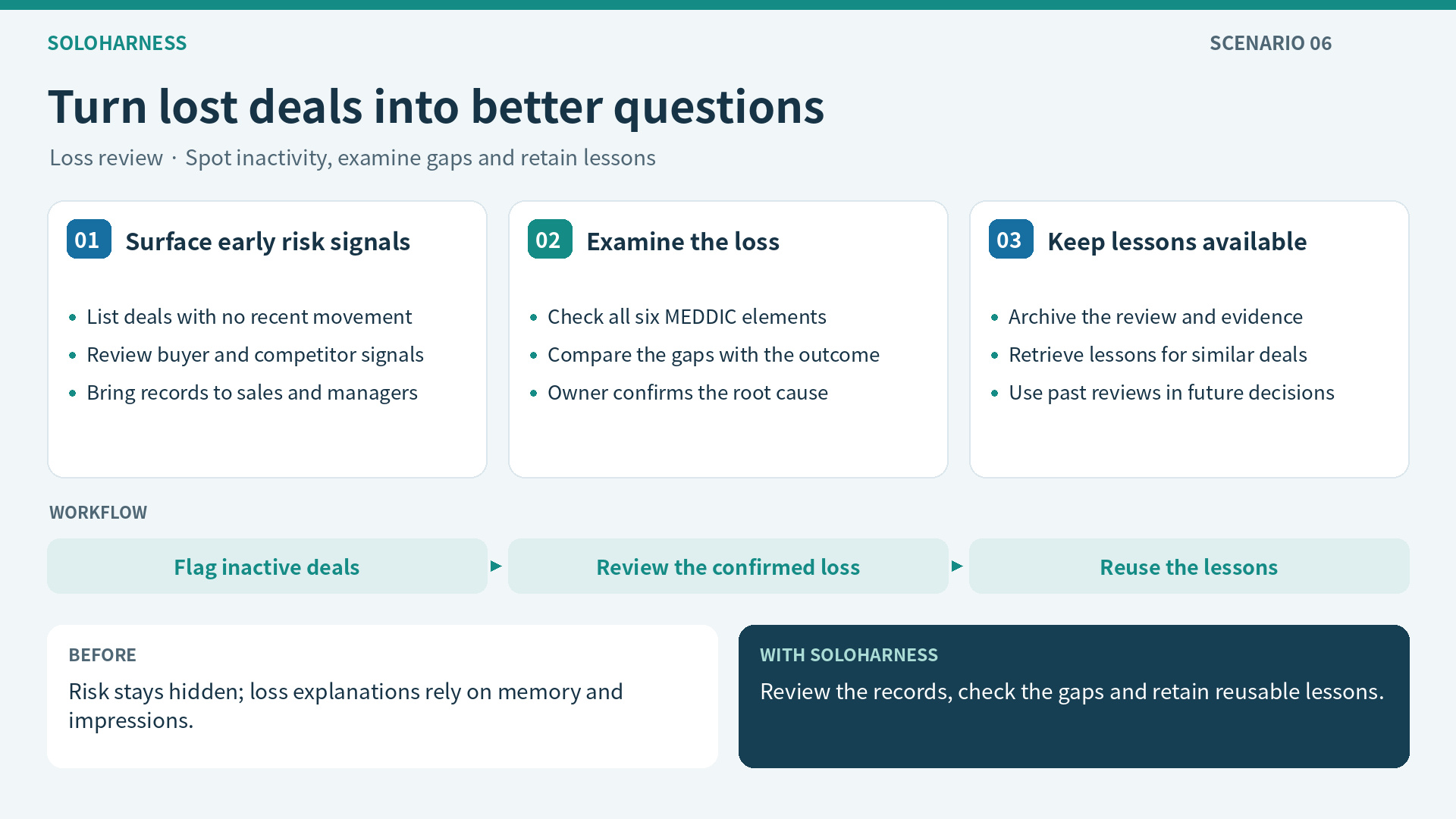
Look at risks first, then save this review for next time's reference
Early warning for stalled stages
When an opportunity enters the "inactive" state defined by the team, list the corresponding records and hand them to sales and managers for review:
🚨 Deal Risk Alert | Company P
Days inactive: 28 days with no new EB contact
Last contact: execution level (technical evaluation)
Competitor activity: Company Q has signed a POC (7 days ago)
EB status: No response to two invitations
Judgment: entering the high-risk zone for lost deals; recommend contacting immediately or initiating a withdrawal assessment
After a loss, check gaps item by item
After the loss outcome is confirmed, the system can organize review materials by the six MEDDIC elements, and the owner confirms the root cause:
📋 Loss Root Cause Report | Company P | 2026-04-20
No confirmed Champion throughout, only contacts at the technical evaluation level
Gave up after two invitations to the EB with no response, without switching outreach paths
Competitor enters mid-cycle, but no effective counter-action during POC phase
Automatic lesson capture + application triggers
Root causes of lost deals confirmed by the person in charge can be stored in the knowledge base; when similar signals appear, the system can suggest references:
⚡ Lesson reuse triggered | Company Q (new opportunity)
Signal detected: Q Company is currently in MEDDIC assessment, Champion = unconfirmed (only one contact with the technical liaison)
Historical lesson matching: P company lost deal root cause = missing Champion
Recommended action: When advancing Company Q, prioritize establishing a Champion before any technical discussion; otherwise the historical pattern is likely to repeat.
Scenario 6 core comparison
| Metrics | Before | After |
|---|---|---|
| Lost-deal findings | You only find out after the other party signs the contract | Inactive records enter the review list as early as possible |
| Root cause analysis | Relying on sales subjective judgment, often goes wrong | Item-by-item check of the six MEDDIC elements |
| Review and archive | No fixed records, so next time you judge from scratch again | Filed after confirmation by the person in charge; can be retrieved for reference when similar signals arise |
| Next similar opportunity | Repeating the same mistake | Lesson-driven early intervention |
Of the deals lost in the last 3 months, how many had a real root cause analysis?
If it's less than half, these lost deals are pure cost, with nothing converted into an asset.