Manager Review · First get the review materials in order
In every team review, managers spend a lot of time listening to sales reports, and the discussion is already over time before it even starts. By organizing process information first, managers can spend their time on judgment and decisions.
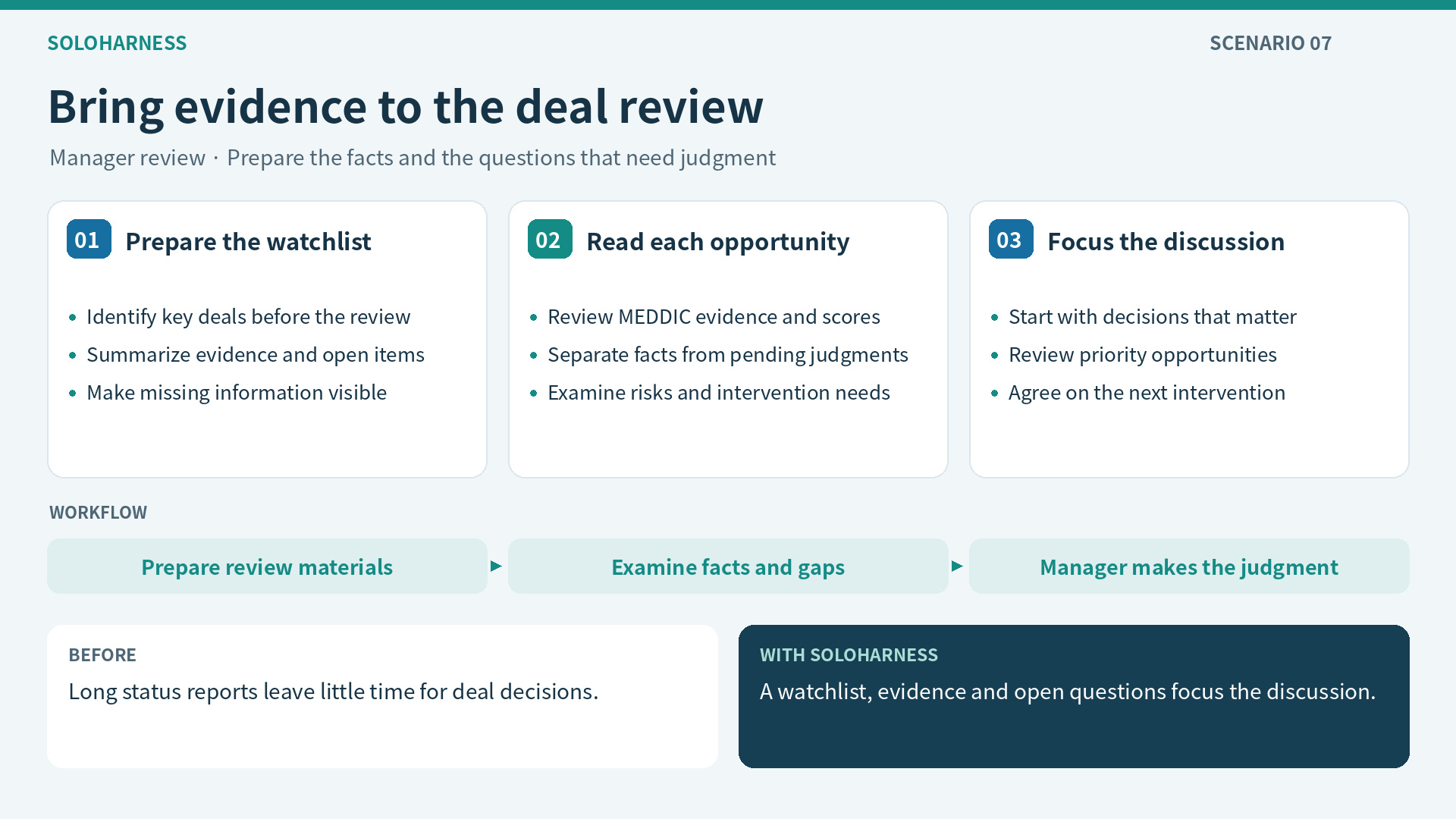
Before the meeting, summarize opportunity facts, progress and information gaps, so the team Review focuses on matters requiring manager judgment.
Three typical dilemmas in manager Review
① Manager reviews become sales reporting meetings with extremely low information density
What happened:Each salesperson spends 5-10 minutes talking about their opportunity progress. By the time the manager has heard 10 people's reports, 90 minutes have passed. Less than 10 minutes is actually available for discussion and decisions. And the content of the sales reports is full of subjective judgments: "The customer is fairly interested," "I feel like this deal is about to close."
Result:The review ended, and the manager felt like they hadn't done anything—no judgment made, no advice given, no direction set, just listened to a report.
② Managers have no data and can only judge by feel
What happened:The manager asks "how is this deal really doing?" and the sales rep says "pretty good." The manager asks "good in what way?" and the sales rep says "the customer is very positive." The manager doesn't know how to push back, because there's no objective data. All they can do is say "hurry up" based on gut feel.
Result:Managers can't truly get involved, missing intervention opportunities at critical moments.
③ Each review takes a long time to prepare, extremely inefficient
What happened:For reviews, managers spend 1-2 hours before the meeting going through each opportunity's CRM record just to have a basic basis for judgment during the review. Otherwise, whatever the salesperson says goes, and they are completely passive.
Result:Managers spend most of their time gathering information, leaving no time for the "judgment" and "decisions" that are actually needed.
Organize the review materials first, so the discussion returns to the matters that need judgment
Prepare a "key deals watchlist" before the review
Before each team Review, the system can compile a manager-level briefing for the manager to check:
📊 This Week's Team Review Brief | 2026-04-26
Coverage: 10 salespeople, 36 active opportunities, 3 requiring manager intervention
🚨 Must Review This Week (3)
• Company R — High risk of losing the deal (no Champion, EB not contacted for over 21 days)
• Company S — requires manager escalation (strategic account; EB wants to meet senior leadership)
• Company T — Competitor entry warning (competitor has signed POC, needs repositioning)
⚠️ Needs observation (5)
Pace warning signal, but not yet in the high-risk zone
AI assessment conclusion for each opportunity—managers see the judgment directly
Managers no longer have to ask reps one by one, "How's this deal going?" The system can aggregate process records for managers to make judgments:
Manager's recommended action: must attend this Friday's Review to assess whether to cut losses and withdraw
Manager's recommendation: maintain the current pace, schedule commercial pricing next week
In Review, lay out the facts and items pending judgment first
During the review, managers can ask the AI at any time:
Manager questions
"Why can't we get confirmation from R Company's Champion? Where is it stuck?"
AI answer
Cause analysis: the contact, Engineer Wang, is a technical evaluation role with no decision-making authority. He said he "needs to align internally first." Historical data shows this is a classic signal of "execution layer wants to push but lacks EB authorization." Recommendation: contact the customer's VP/GM level directly to break through the execution-layer bottleneck.
Scenario 7 Core Comparison
| Metrics | Before | After |
|---|---|---|
| Review preparation | Manager spends 1-2 hours reviewing the CRM themselves | Summarize evidence and pending items first, then the manager reviews in a few minutes |
| Information sources | Subjective sales reporting, low density | AI objective assessment, MEDDIC scoring |
| Engage in the decision | Based on gut feeling, no way to intervene early | System prompts + manager judgment to decide whether to intervene |
| Review efficiency | 90% of time listening to reports, 10% deciding | 20% of time reading reports, 80% of time making decisions |
How many deals can your team truly discuss in one Review?
If the average is under 5, there's huge room to improve Review efficiency.