Next Action · Five-Element Precise Action
The emptiest thing salespeople say: "I'll contact him next week." Three weeks later nothing has changed—because at the time they didn't even know what to contact him about. Only by writing the next step with five clear elements do you get a checkable progression action.
Write the next action with a clear owner, participants, timing, objective and completion evidence, so the team can follow up and check.
Four real scenarios where "next step" becomes empty talk
① "I'll reach out next week" — no contact, no topic, nothing
Real scenario:The manager asks "how do we push this customer forward next?" The salesperson says "I'll contact him next week." The manager says "OK." Next week arrives, the salesperson can't remember what they wanted to discuss, so they just make a random call. The customer says "I'm busy lately, let's do it another time." Only after hanging up does the salesperson realize: no useful information came out of this call.
Why it is ineffective:"Contact the customer" is only an intention; the action is not yet clearly defined. Without an action object, a topic or completion criteria, this "contact" will most likely just be a greeting.
② No idea where the bottleneck is, only able to mechanically repeat "let me try again"
Real scenario:The salesperson knows this deal isn't moving forward, but doesn't know where the problem is. When the manager asks "why hasn't there been progress," the salesperson can only say "I'll try again." In fact, they have no idea what to "try." So they call this week, call again next week, with exactly the same content, and the customer gives exactly the same response—the deal stays stuck in place.
Why it is ineffective:Without first identifying the bottleneck, it's hard to arrange the right actions. Repeating the same outreach often just continues to drain the sales team's time and patience.
③ Complete dropout after holidays/long breaks
Real scenario:On the last visit before the holiday, the client raised a concern: "I'm a bit worried about your delivery capability. Can you guarantee the go-live date?" The salesperson said, "I'll look into it and get back to you on Tuesday." Then the holiday came. When Tuesday arrived, the salesperson had completely forgotten, and the client's concern went unanswered. In the first week after the holiday, the client proactively asked, "Have you confirmed that delivery date?" Only then did the salesperson remember — but the client's impression was already very poor.
Why it is ineffective:Without a handover mechanism and without post-holiday reminders, the "promises" salespeople make to customers fall through because there is no system tracking. Every such failure erodes customer trust.
④ Following 20 customers, time is taken up by the one most recently contacted
Real scenario:A salesperson handles 20 customers, busy from 9 a.m. to 6 p.m. The reality is: they dealt with the 3 customers who contacted them today, and took no action at all on the other 17. The problem isn't willingness, it's that they don't know what each customer should be advancing right now.
Why it is ineffective:A reactive mode keeps sales perpetually handling things that have "already gone wrong," while proactively advancing the opportunities "most worth advancing" gets pushed to the back.
Five-element precise actions + intelligent scheduling
Every action is a task card
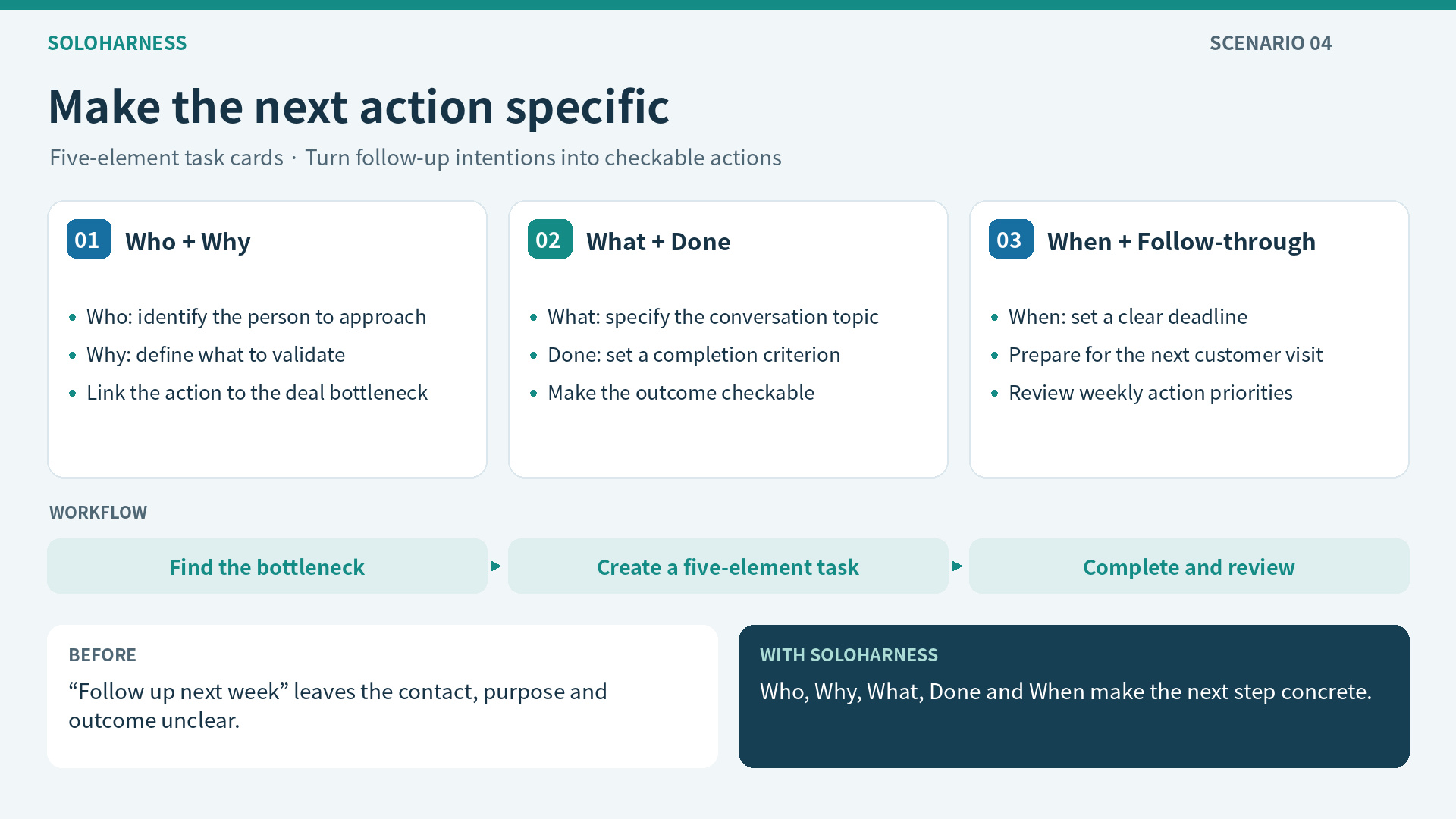
The AI-generated next action turns from "contact the customer" into a completeFive-element task card:
Who to Approach
Engineer Wang · Technical contact
What to validate
Delivery timeline feasibility
What to discuss
Confirm milestones for each POC stage
Completion criteria
Confirm delivery time by email
Deadline
By Thursday 18:00
💡 After an action is completed, the system can prompt the next five-element task; whether to continue advancing is still confirmed by the owner.
Automatic follow-up when visits lapse
After each visit, the system can prepare "next visit preparation" for the sales rep to review:
- Where we left off last time:The customer's core concerns are delivery time + implementation team experience
- Points to confirm:Whether delivery time commitments require written confirmation
- New topic for this session:If there is no delivery risk, the next step is to advance to a meeting with the EB
📌 Post-holiday follow-up reminder
Automatically pushed at 09:00 on the first workday after the holiday: "You promised before the holiday that Engineer Wang would confirm the delivery time. Please confirm whether the email has been sent. If not, prioritize it today."
Monday checklist: "Which action moves this forward half a step this week?"
Every Monday morning, first compile a "this week's action list" by opportunity priority and recorded bottlenecks, then have the manager and sales rep confirm the order:
Reason: The EB has confirmed availability for an in-person meeting on Friday (key gap); this week is the only window to reach the EB
This week's K and M deals are on hold; this week's actions cannot change their advancement status
Reason: A competitor is already involved, so outreach frequency needs to increase; this week's actions can advance to EB contact
L and M deals on hold this week
Scenario 4: Core Comparison
| Metrics | Before | After |
|---|---|---|
| Action Definitions | "Contact the customer" (no substantive content) | Five-element task card (all required) |
| Bottleneck awareness | Not knowing where the problem is—"let me try again" | List bottlenecks based on records, for the owner to decide the next step |
| Cross-cycle continuity | Complete drop-off after holidays | List next-time preparations and post-holiday reminders in advance |
| Priority | Passive "whoever chases, follow them" | List this week's pending items according to agreed rules, then have the owner prioritize them |
For each of your sales follow-ups, how many task cards have all five elements complete?
If it's less than half, deal progression efficiency is cut by at least 50%.